
Affordable Housing
Production Note:
You are viewing this report microsite on a mobile device. While most content is optimized for mobile, the data dashboards are best experienced on a tablet or desktop due to their interactive features.
Safe, stable, and affordable housing is a foundation for economic well-being. Yet across Forsyth County, the cost of renting or buying a home has risen faster than many residents’ incomes, creating barriers that affect women and girls, particularly those of color. Housing costs shape where families can live, the opportunities available to them, and the amount of income they have left for essentials like food, transportation, and childcare.
This section explores several indicators of housing affordability, including rent and home values, the share of neighborhoods residents can afford, and gaps between the number of affordable units and the number of households that need them.
Key Findings from the Community Cohort
The Community Cohort (Cohort) is a group of local women and people whose lived experiences reflect womanhood—especially Black and Latine parents—who helped shape this report by sharing their real-life experiences, priorities, and interpretations so the data reflects what thriving (and struggling) actually looks like in our community.
Racial disparities in access to affordable housing, particularly for Black residents, are large.
- The cohort observed that this is an indication that the system is built to disadvantage Black residents and advantage white residents – it’s systemic oppression.
- Systemic barriers make it challenging for Black and Latine women in particular to be financially stable, even when they “make the right decisions.”
High housing values are concentrated in a relatively small number of census tracts
Racial disparities in who can afford to purchase a house are stark, particularly for Black women.
Racial disparities in the number of census tracts residents can afford to rent or buy in are huge, even when you break it down by household type.
- For example, the median percentage of the census tracts in which Black households headed by single females could afford to rent is 23%.
- This shows that income and housing costs are significantly constraining where families of color can live.
There are ~10,000 units too few for lower-income renters and ~10,000 units too many for middle- to higher-income residents.
Alongside the data, the Cohort offers insights that highlight how longstanding racial and gender inequities influence who has access to stable and affordable homes.
This section focuses on affordable housing, and the Cohort felt it was important to frame this discussion with some information about homelessness in Forsyth County because homelessness is impacted by housing affordability. People are currently experiencing homelessness in Forsyth County. According to the 2025 PIT Count, 478 people were experiencing homelessness, 42% of whom were unsheltered. Homelessness affects people across many races, ethnicities, and genders: a third of those counted were women and girls, and about half were Black or African American.”
The 2026 Gender Lens Report
The 2026 Gender Lens Report
Median Rent and Housing Value
This measure helps show what housing really costs across our community—whether renting or owning—and why many families feel squeezed as home values and rents rise faster than incomes or expectations. It also reflects residents’ own estimates of home value, which may not always keep pace with the market.
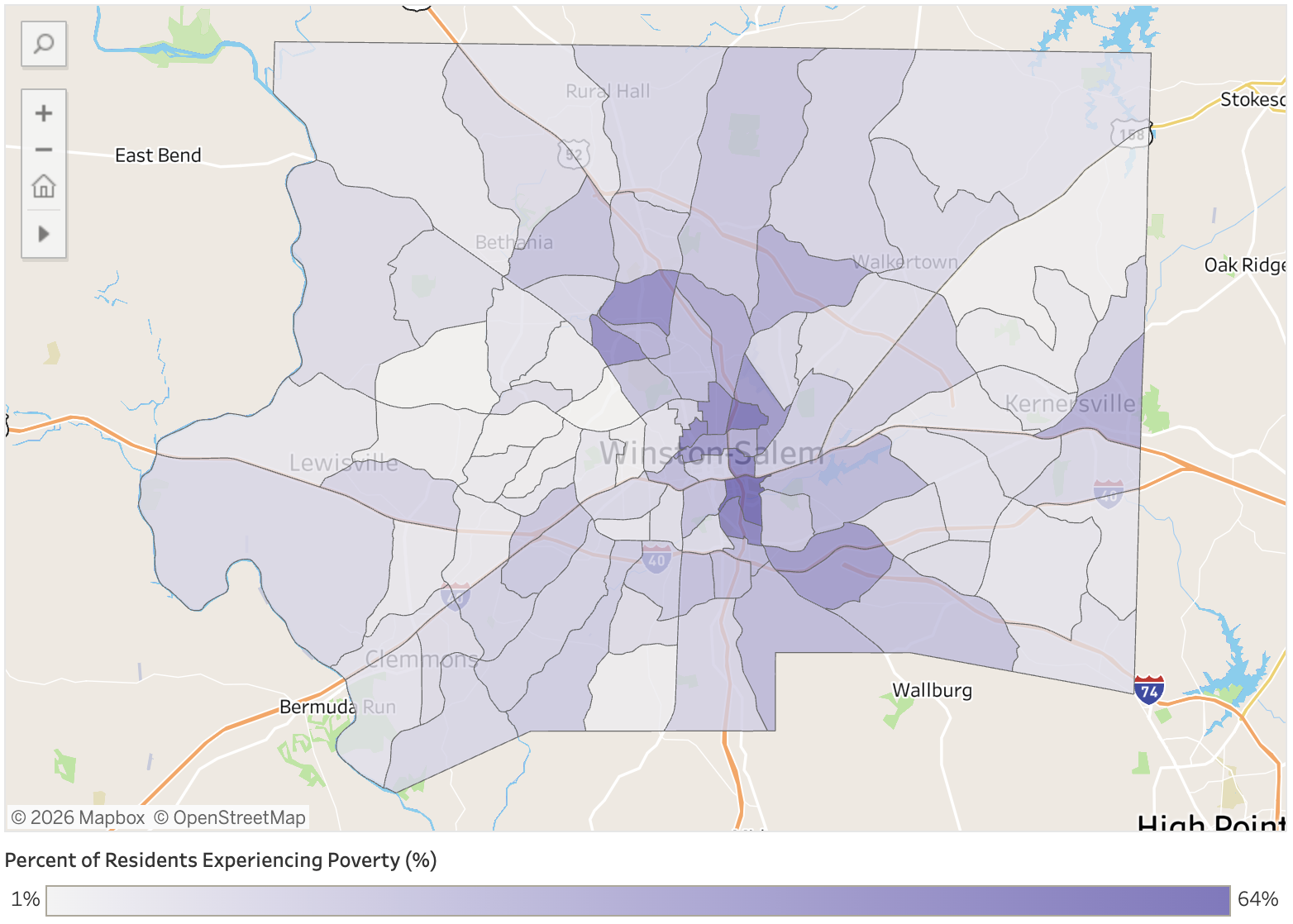
The map below adds important context by showing where higher poverty rates overlap with housing costs. Together, these patterns highlight how housing choices are shaped by longstanding inequities—where lower-income households are more likely to be concentrated in neighborhoods that have had fewer investments and opportunities. This underscores the reality that affordability is not just about cost, but about access to safe, stable housing and the conditions that support wellbeing.
Data Visualization
Median Home Values and Rent by Census Tract (5-year Periods from 2009-2013 to 2019-2023)
Use the buttons below to toggle between rent and home value.

The following map adds context by showing where poverty rates are higher across the county, allowing readers to compare these patterns alongside housing costs and better understand how neighborhood conditions shape affordability.

Community Voices
One participant points to utilities—especially propane and electricity—as her primary housing stressor, explaining that combined monthly bills can reach nearly $500 even when she is budgeting carefully. For her, wages are not failing because of irresponsible spending; they are outpaced by non‑negotiable infrastructure costs.
Median Rent and Housing Value
Home value reflects what respondents estimate their owned property to be worth, while gross rent reflects the typical monthly housing cost paid by renter households, including rent and estimated average monthly utility costs. Both are reported as medians, meaning the middle value where half are lower and half are higher.
The CBPR cohort directing this report felt like it was important to emphasize that homes may actually be worth more than their residents estimate, especially if homeowners have not been paying attention to the housing costs around them. And, the value of houses in general may be different than the values of housing that is for sale. For example, between 2019 and 2023, the median house value reported to the Census Bureau was about $243,000 in 2024 dollars. Redfin, a real estate website, indicates that the median sale price of a house that was sold in Forsyth County, NC, in October 2025 was $305,000.
The CBPR cohort had a particular question about how low rent appears in tract 3.01. Analysts examined this data. It has a very high margin of error and may not be reliable.
The CBPR cohort also thought that it was important to look at the cost of rent and the value of homes in the context of other neighborhood factors, like poverty.
This map shows the poverty rate for each census tract in Forsyth County over the time period between 2019 and 2023.
More maps that the cohort suggested could provide important context for this information can be found at the Forsyth County Neighborhood Opportunity Atlas.
Data Notes
Median Rent and Housing Value
Percent of Households with Children 12 and Under Burdened by Childcare Costs
About the Measures
- Results can be less precise for some census tracts than others, especially where fewer survey responses are available.
Data Sources
- American Community Survey (ACS) 2023 5-year data and a Consumer Price Index (CPI) to adjust for inflation from 2023 to 2024.
Citations
- U.S. Census Bureau (2024). Median Value (Dollars) [Table B25077]. 2023 American Community Survey 5-Year Estimates. Retrieved from data.census.gov.
- U.S. Census Bureau (2024). Median Gross Rent (Dollars) [Table B25064]. 2023 American Community Survey 5-Year Estimates. Retrieved from data.census.gov.
- U.S. Bureau of Labor Statistics. (2025, March 21). Consumer Price Index: R-CPI-U-RS Homepage. Retrieved from https://www.bls.gov.
- Redfin. (n.d.). Forsyth County, NC housing market. https://www.redfin.com/county/2040/NC/Forsyth-County/housing-market
- U.S. Census Bureau. (2025). American Community Survey (ACS), 5-year public use microdata sample (PUMS), 2013–2023. https://www.census.gov/programs-surveys/ acs/microdata.html
Housing Affordability
This indicator estimates the percentage of census tracts in which residents can afford to rent or buy homes and reports the median percentage of census tracts that different groups of people can afford. The median percentage means that about half of the households in that group could afford a smaller percentage of census tracts, and about half could afford more.
This measure uses the rent and housing value data from the Median Rent and Housing Value by Census Tract measure to estimate the cost of renting or buying a home.
For this measure, rent is considered affordable if it is less than 30% of a household’s monthly income, and home values are considered affordable if they are less than three times the household’s annual income.
The CBPR cohort felt like it was important to emphasize that homes may actually be worth more than their residents estimate, especially if homeowners have not been paying attention to the housing costs around them. And, the value of houses in general may be different than the values of housing that is for sale. For example, between 2019 and 2023, the median house value reported to the Census Bureau was about $243,000 in 2024 dollars. Redfin, a real estate website, indicates that the median sale price of a house that was sold in Forsyth County, NC, in October 2025 was $305,000. The cohort also felt that it was important to emphasize that a limited number of houses are up for sale at a particular time. For example, Redfin reports that 443 homes were sold in Forsyth County during October of 2025.
This analysis also does not take into account savings, credit history, or racial discrimination in renting and lending, which the cohort identified as other factors that influence the ability to rent or own a home.
The CBPR cohort also thought that it was important to look at the cost of rent and the value of homes in the context of other neighborhood factors, like poverty.
The map below shows the poverty rate for each census tract in Forsyth County over the time period between 2019 and 2023. Click on the map to go to an interactive version of the map.
More information that the cohort suggested could provide important context for this information can be found at the Forsyth County Neighborhood Opportunity Atlas.
Data Visualization
Median Percentage of Census Tracts Households Can Afford to Rent or Buy In (5-year Periods from 2009-2013 to 2019-2023)

Community Voices
Women repeatedly describe housing as a series of forced tradeoffs. For some, it is impossible to find a home that is simultaneously affordable, safe, and culturally affirming.
One mother explains that as her children grew older, the social costs of living in predominantly white spaces became intolerable. Housing decisions were never just about a mortgage or square footage; they were about how much racial isolation her Black children would be expected to navigate every day:
“We cannot go to an all white church. We cannot add any more all white spaces to the thing at this point.”
She and her partner narrowed options using overlapping filters—crime data, school location, price, and racial dynamics. Potential homes that met one need often failed another. In order to leave a higher‑crime neighborhood, they ultimately moved into a whiter, more expensive community they did not want to be in. They gave up a culturally affirming environment and social‑emotional safety for their family in exchange for greater physical safety and higher housing costs. Stability, in her story, is the outcome of eliminating unacceptable risks one by one until only a few painful, imperfect choices remain.
One woman and her partner tried to rent their first home after college with steady but low‑status jobs and no rental history. On paper, they were not “ideal tenants.” They only secured a lease because his parents co‑signed, bypassing institutional standards through family relationships. Rent then climbed by about $100 every year, making a modest home steadily less affordable over time.
[…] distance and transportation reshape what “affordable” means. A home that looks manageable on paper becomes unaffordable once she adds rideshares, longer commutes, and time away from children. A place is only affordable if it does not quietly drain what little margin is left beyond rent and utilities.
One survivor of domestic violence explains that a court order did little to protect her. Her children’s father continued to break in and harass them. Because she could not afford more expensive parts of town, she was repeatedly placed wherever housing providers had availability, even when these placements kept her within reach of her abuser. She describes being unable to sleep, unsure if the home assigned to her would actually keep her family safe.
Data Notes
Housing Affordability
Median Percentage of Census Tracts Households Can Afford to Rent or Buy In
Data Notes
- The Census Bureau considers everyone who lives together to be a “household”. These people may not always share expenses or responsibilities for children.
- The Census Bureau did not include same-sex married couples as married couples in their data until the 2015-2019 data.
Tracts Affordable to Rent
- Analysts are at least 95% sure that apparent differences by race/ethnicity of householder, household type, and detailed household type are real.
- White, non-Hispanic married couple households are different from other households.
- Black, non-Hispanic single female households are different from every other group except Black, non-Hispanic single male households.
- Data about Black or African American, non-Hispanic male householders without spouses and Hispanic/Latine householders without spouses are uncertain and should be interpreted carefully.
Tracts Affordable to Own
- This estimate is based on income and does not consider a household’s wealth or credit.
- Analysts are at least 95% confident that all apparent differences by race/ethnicity of householder and household type are real.
- Analysts are not sure whether the differences between married or cohabitating opposite-sex couples and same-sex couples are real, but all of the other differences by detailed household type are significant.
- Married-couple households by race are different from all other race/ethnicity and household types.
- Black female headed households may not be different from Black male-headed households or Hispanic/Latine-headed households, but they are different from all other race/ethnicity and household types.
- Black male headed households, Latine female headed households, and Latine male headed households estimates are imprecise and should be interpreted with caution.
Data Sources
- American Community Survey (ACS) 2019-2023 5-year data
Citations
- U.S. Census Bureau. (2025). American Community Survey (ACS), 5-year public use microdata sample (PUMS), 2013–2023. https://www.census.gov/programs-surveys/ acs/microdata.html
- U.S. Census Bureau (2024). Median Value (Dollars) [Table B25077]. 2023 American Community Survey 5-Year Estimates. Retrieved from data.census.gov.
- U.S. Census Bureau (2024). Median Gross Rent (Dollars) [Table B25064]. 2023 American Community Survey 5-Year Estimates. Retrieved from data.census.gov.
- Redfin. (n.d.). Forsyth County, NC housing market. https://www.redfin.com/county/2040/NC/Forsyth-County/housing-market
Adults Who Could Buy a Home
This measure is an estimate of the share of adults (age 18 and older) living in households with incomes high enough to purchase the median, or middle, cost home in Forsyth County. To make this estimate, analysts used financial guidance that many households can afford to purchase a house that is two to three times their annual household income. To avoid overestimating how many people could afford a house, analysts used the higher end of that advice and estimated that a household could afford to buy a middle-value home if its value was less than three times their annual income.
The Community Cohort directing this report felt like it was important to emphasize that homes may actually be worth more than their residents estimate, especially if homeowners have not been paying attention to the housing costs around them. And, the value of houses in general may be different than the values of housing that is for sale. For example, between 2019 and 2023, the median house value reported to the Census Bureau was about $243,000 in 2024 dollars. Redfin, a real estate website, indicates that the median sale price of a house that was sold in Forsyth County, NC, in October 2025 was $305,000. The cohort also felt that it was important to emphasize that a limited number of houses are up for sale at a particular time. For example, Redfin reports that 443 homes were sold in Forsyth County during October of 2025.
This analysis also does not take into account savings, credit history, or racial discrimination in renting and lending, which the cohort identified as other factors that influence the ability to rent or own a home.
Data Visualization
Percent of Adults Living in Households with Enough Income to Purchase Home (5-year Periods from 2009-2013 to 2019-2023)

Community Voices
[…] another tried to buy a home alone after divorce. The only asset she had was four acres of land from the settlement—deeply meaningful to her, but functionally invisible to lenders. Because her name had been on property deeds during marriage, she no longer qualified as a first‑time homebuyer, yet she had none of the wealth or security that ownership is supposed to produce. In her words, she was treated like someone with “no assets,” disqualified from support for having had a life before.
Data Notes
Adults Who Could Buy a Home
Data Notes
- Median Home Value is from the ACS Survey, which asks, “About how much do you think this house and lot, apartment, or mobile home (and lot, if owned) would sell for if it were for sale?”
- The Census Bureau considers everyone who lives together to be a “household”. These people may not always share expenses or responsibilities for children.
- The Census Bureau did not include same-sex married couples as married couples in their data until the 2015-2019 data.
- Race/Ethnicity and Race/Ethnicity x Sex differences:
- Across most years, differences between white residents and other racial groups appear more consistent than differences between Black or African American residents and Hispanic or Latine residents.
- When looking at race by sex, differences between white women and white men tend to be clearer. Some years also show statistically significant differences involving Black women, Black men, Hispanic women, or Hispanic men, but these vary year to year.
- In short, some gaps are more stable over time (e.g., white vs. others), while others may look meaningful in one year but not in another.
Data Sources
- American Community Survey (ACS) 2013 to 2023 5-year data
Citations
- U.S. Census Bureau. (2024). American Community Survey (ACS), 5-Year Public Use Microdata Sample (PUMS), 2009-2023. Retrieved from Public Use Microdata Sample (PUMS).
- U.S. Bureau of Labor Statistics. (2025, March 21). Consumer Price Index: R-CPI-U-RS Homepage. Retrieved from https://www.bls.gov.
- Federal Deposit Insurance Corporation. (n.d.). Loans and mortgages how much mortgage can I afford?. Federal Deposit Insurance Corporation. https://www.fdic.gov/consumers/consumer/moneysmart/podcast/documents/borrowing-money-how-much-mortgage-can-i-afford.pdf
- Redfin. (n.d.). Forsyth County, NC housing market. https://www.redfin.com/county/2040/NC/Forsyth-County/housing-market
Change in Home Values and Income
This measure looks at how median house values and median employment income have changed since 2013. The percent change shows whether the median (middle) house value or employment income is higher or lower compared to its 2013 level. A positive number means it increased, and a negative number means it decreased.
The Community cohort directing this report felt it was important to emphasize that homes may actually be worth more than their residents estimate, especially if homeowners have not been paying attention to the housing costs around them. And, the value of houses in general may be different than the values of housing that is for sale. For example, between 2019 and 2023 the median house value reported to the Census Bureau was about $243,000 in 2024 dollars. Redfin, a real estate website, indicates that the median sale price of a house that was sold in Forsyth County, NC, in October 2025 was $305,000.
Data Visualization
Percent Change in Median Employment Income and Home Value in Forsyth County, NC in 2024 Dollars (5-year periods from 2009-2013 to 2019-2023)

Data Notes
Change in Home Values and Income
Data Notes
- Median home value comes from the ACS question: “About how much do you think this house and lot, apartment, or mobile home (and lot, if owned) would sell for if it were for sale?” Calculated at the household level for owner-occupied units.
- Median employment income is based on annual wage and salary earnings among individuals who are civilians, ages 16–64, and employed.
- All dollar amounts are in 2024 dollars to control for inflation.
- Total / County-Wide:
- The increase in household home values from 2013 to 2023 is statistically meaningful.
- Person-level employment income fluctuates year to year, but the overall change between 2013 and 2023 is not statistically meaningful.
- Across demographic groups, the differences between the following groups appear to be real:
- By Sex: Males compared to females
- By Race: Non-Hispanic, white compared to Non-Hispanic, Black or African American and Latine
- By Race and Ethnicity and Sex:
- Non-Hispanic white males and females have the highest employment incomes, and these differences compared to other groups are meaningful.
- Hispanic or Latine females have the lowest employment incomes, and these differences compared to every other group are also meaningful.
Data Sources
- American Community Survey (ACS) 2013-2023 5-year data and a Consumer Price Index (CPI) to adjust for inflation (2024 dollars).
Citations
- U.S.Census Bureau. (2025). American Community Survey (ACS), 5-year public use microdata sample (PUMS), 2013–2023. https://www.census.gov/programs-surveys/ acs/microdata.html.
- U.S. Bureau of Labor Statistics. (2025, March 21). Consumer Price Index: R-CPI-U-RS Homepage. Retrieved from https://www.bls.gov.
- Redfin. (n.d.). Forsyth County, NC housing market. https://www.redfin.com/county/2040/NC/Forsyth-County/housing-market
Homeownership Rate
The homeownership rate is the percentage of Forsyth County residents who live in a home owned by someone in the household, including both those with a mortgage and those who own their homes free and clear.
Data Visualization
Homeownership Rate (5-year periods from 2009-2013 to 2019-2023)

Community Voices
“It’s old and it’s small, but it’s ours. Nobody can take it from me and my family.”
Data Notes
Homeownership Rate
Data Notes
- Sex of adults represents adults 18 and over
- The Census Bureau considers everyone who lives together to be a “household”. These people may not always share expenses or responsibilities for children.
- The gap between adult males and females living in owned homes appears to be a real difference over time
- Race/ethnicity disparities also appear to be real differences over time, but any apparent differences between Black and Hispanic/Latine respondents could be random chance
- Decline among Black residents living in owned homes from 2009–2013 to 2014–2018 appears to be real, as does the recent increase from 2014–2018 to 2019–2023
- When looking at both race/ethnicity and sex of adults, differences between homeownership among white males and white females and their respective counterparts appear to be real.
Data Sources
- American Community Survey (ACS) 2013-2023 5-year data
Citations
- U.S. Census Bureau. (2025). American Community Survey (ACS), 5-year public use microdata sample (PUMS), 2013–2023. https://www.census.gov/programs-surveys/ acs/microdata.html
Affordable Housing Shortage
Measure Description and Context: For each income band, analysts compared renter households to the number of units that are both affordable (costing no more than 30% of household income) for that band and available to rent.
- Positive numbers = shortage (not enough affordable, available units).
- Negative numbers = surplus (more units than renter households).
AMI stands for Area Median Income, the middle income for the Winston-Salem, NC, HUD Metro Area. These income ranges take family size into account and are different for different family types. The list below provides example income ranges for a family of four for the fiscal year 2025.
- 30% AMI: $26,000
- 50% AMI: $43,350
- 80% AMI: $69,350
Data Visualization
Affordable Housing Shortage (2017-2021)

Community Voices
Due to their immigration status, they often live in overcrowded conditions, paying exorbitant rents for dilapidated spaces, disproportionate prices for homes that don’t meet basic standards, and sometimes facing eviction threats or unjustified rent increases. These women are often excluded from public assistance programs and are forced to accept whatever they can find, even when the housing is unsafe for them and their children. I know that home stability is fundamental to the well-being of families, but I also know that for many of my clients, a decent home is sometimes a distant dream.
Youth who age out of care face higher rates of homelessness, unemployment, education disruption, and incarceration than the general population. The National Youth in Transition Database (NYTD) tracks outcomes of youth who age out by following up with them at ages 17, 19, and 21. Housing instability continues to remain one of the most significant challenges faced by these youth. Oftentimes, they report either being homeless or bouncing from place to place. Housing instability compounds other issues such as education progress and employment due to the foundational need to have a stable home to return to while attempting to meet educational goals or employment requirements. It can become cyclical because then in turn, they are not able to have sufficient financial resources to stabilize where they live. When a young adult has to focus on where they are going to lay their head that night, it makes it impossible to think about their future much past tomorrow. Goals such as career exploration, job training, and future financial planning all become out of reach because they are focused on their most basic immediate needs.
Data Notes
Affordable Housing Shortage
Data Notes
- AMI stands for Area Median Income, the midpoint of household income in the county. HUD often classifies renters into income categories:
- Extremely low income: ≤30% of AMI
- Very low income: 31–50% of AMI
- Low income: 51–80% of AMI
- Moderate to higher income: Over 80% of AMI
- Margins of error show that shortage estimates are less stable for higher-income renter households.
- In CHAS, “available” units include both those already occupied at that rent level and those vacant. Because of this, the data cannot show whether shortages, especially among extremely low-income renters (≤30% AMI), are due to too few units at that price point or because higher-income households are living in units that would otherwise be affordable to lower-income households.
Data Sources
- HUD’s CHAS data which reflects 2017-2021 time period (2021 5-Year ACS).
Citations
- U.S. Department of Housing and Urban Development’s Office of Policy Development and Research (PD&R). (n.d.). FY2025 Adjusted Home Income Limits. HUD User. https://www.huduser.gov/portal/datasets/home-datasets/files/HOME_IncomeLmts_State_NC_2025.pdf
- U.S. Department of Housing and Urban Development. (2024). Comprehensive Housing Affordability Strategy (CHAS) data, based on 2017–2021 American Community Survey 5-year estimates. Retrieved from https://www.huduser.gov.