
Access to Childcare
Production Note:
You are viewing this report microsite on a mobile device. While most content is optimized for mobile, the data dashboards are best experienced on a tablet or desktop due to their interactive features.
Access to affordable, high-quality childcare is a key component of economic well-being for women, girls, and their families. When childcare is too expensive or too limited, it can affect parents’ ability to work, pursue education, or meet basic household needs. These challenges do not affect all families equally. Differences in household income, family structure, race and ethnicity, and the availability of childcare options across neighborhoods all shape how childcare access is experienced in Forsyth County.
This section looks at several indicators related to childcare affordability and access. It includes estimates of how many households are burdened by childcare costs, how much of their income families with childcare expenses may need to spend, the number and quality of childcare facilities available, and the share of families living in childcare deserts.
Key Findings from the Community Cohort
The Community Cohort (Cohort) is a group of local women and people whose lived experiences reflect womanhood—especially Black and Latine parents—who helped shape this report by sharing their real-life experiences, priorities, and interpretations so the data reflects what thriving (and struggling) actually looks like in our community.
An estimated 39% of all households with children 12 and under are burdened by childcare costs.
- This includes more than half of Black households and about 40% of Latine households.
- About half of households with children 12 and under who need childcare would need to pay 13% of their household income or more to afford high-quality childcare.
- The percentage of income that households would need to pay for high-quality childcare varies significantly by race and family structure.
Black and Latine female householders generally carry a disproportionate burden of childcare costs.
- An estimated 63% of households headed by Black female householders and 52% of households headed by Latine female householders are potentially burdened by their childcare costs.
- An estimated 23% of households headed by white, non-Hispanic married couples are burdened by childcare costs.
- About half of households that analysts estimate have childcare costs and are headed by single Latine females would need to spend more than 30% of their household income on childcare.
- For households headed by single Black females, that number is 27%.
- For households headed by white, married couples, it is 8%.
- One of the cohort members observed that, “single moms need help, a lot of help.”
Cohort members noted that burdensome childcare costs disproportionately harm low-income families and that some families have higher costs than those reflected in the analysis.
- Cohort members pointed out that residents with lower incomes have less disposable income, which means that spending a higher percentage of income on childcare impacts them more than it would higher-income families.
- They also noted that kids with special needs may have to pay more for childcare arrangements, and they have additional out-of-pocket costs.
- The cohort also pointed out that childcare expense estimates are based on market rates, and some childcare centers charge more than the market rate.
The Cohort helped guide the analyses on this page, highlighting the importance of understanding how childcare intersects with broader issues, such as family income, single parenthood, and the higher costs faced by families of children with special needs.
Together, these measures provide a clearer picture of the barriers many families face and the unequal impact of childcare challenges across the community.
The 2026 Gender Lens Report
The 2026 Gender Lens Report
Childcare Cost Burden
This measure estimates the percentage of households with children 12 and under that are cost-burdened by childcare. It shows how many families with young children are spending such a large share of their income on childcare that it strains their ability to cover other basic needs, helping explain why childcare costs can feel like a breaking point for many households in our community. It is based on estimated childcare costs and household incomes, using a common benchmark that considers families cost-burdened when childcare exceeds 10% of income, a threshold that disproportionately affects lower-income households and families with fewer working adults.
Data Visualization
Percentage of Households with Children 12 and Under Who are Cost-Burdened by Childcare (5-year Periods from 2009-2013 to 2019-2023)

Community Voices
…many undocumented women work jobs with irregular hours, low wages, and no benefits. Sometimes their lack of documentation prevents them from accessing subsidized childcare programs. I’ve heard how they are forced to leave their children with neighbors, distant relatives, or even alone for periods of time, all to avoid losing the only income that sometimes sustains the family. This situation limits their ability to maintain stable employment and affects their emotional well-being, and in many cases, exposes them to labor exploitation.
Participants describe long waitlists, confusing county‑level rules, and paperwork that is hard to complete while juggling work, transportation, and caregiving:
“You can qualify, but actually getting the help is a whole other story… by the time they call you back, your situation has already changed.”
Families move in and out of structured early learning and after‑school programs, filling gaps with relatives or children staying home. These interruptions directly affect school readiness, attendance, and learning routines. For children, this can mean inconsistent exposure to early literacy, fewer chances to build relationships with teachers, and more transitions between care arrangements.
Childcare Cost Burden
This measure estimates the percentage of households with children 12 and under that are cost-burdened by childcare.
Analysts labeled a household childcare cost-burdened if it contained a child 12 or under and its estimated childcare costs are more than 10% of its household income. Analysts estimated childcare costs using the following assumptions:
- If someone over the age of 21 in the household is unemployed or not working, the household does not need childcare. So, that household’s expenses are 0.
- All children under 5 are enrolled in 4-star childcare at the market rate.
- All children 5-12 are enrolled in summer and after-school care.
Analysts estimated each household’s childcare costs by adding the cost of childcare for all children under 12 in the household. They then used this sum and the household’s income to estimate what percentage of their income a household would need to spend on childcare.
For example, if a household making $100,000 a year had estimated childcare expenses that were more than $10,000 a year, it would be considered cost-burdened. A household making $50,000 a year would be cost-burdened if it needed to spend more than $5,000 a year on childcare. Households with lower incomes are more likely to be cost-burdened because the 10% threshold is lower for those households. Households with fewer working adults are more likely to be cost-burdened because fewer working people generally result in lower household incomes.
This analysis includes all households with children 12 and under, not just those that analysts estimate have childcare expenses. This is different from the Median Percentage of Income Needed for Childcare for Households with Children 12 and Under who Need Childcare measure, which only looks at childcare costs for households with childcare expenses.
Analysts noted that they had to make some assumptions about who needed childcare and how much it would cost. These assumptions may not be true for everyone. For example, some households may have grandparents who live outside of the household, providing childcare for free, and some childcare facilities charge more than the market rate. These numbers reflect analysts’ best estimates.
The Community Cohort directing this report felt that sharing differences in household income by race and ethnicity was important for helping readers understand this analysis. The list below shows the median income of households with children 12 and under in Forsyth County by race and ethnicity from 2019-2023. The median is the income that half of the people in a group are above, and the other half are below:
- Black or African American, non-Hispanic: $43,412
- Hispanic or Latine: $48,686
- White, non-Hispanic: $106,843
The Community Cohort also thought it was important to emphasize that care for children with special needs may be more expensive, and that those families may experience other additional costs that impact their economic well-being. A 2019 study found that expenses for families with special needs in the United States could be as high as $69,500 a year, about $88,000 in 2025 dollars.
Data Notes
Childcare Cost Burden
Percent of Households with Children 12 and Under Burdened by Childcare Costs
About the Measures
- This analysis uses the market rate for the end of the 5-year time period.
- This analysis does not reflect any subsidies that families receive.
- The Census Bureau considers everyone who lives together to be a “household”. These people may not always share expenses or responsibilities for children.
- The Census Bureau did not include same-sex married couples as married couples in their data until the 2015-2019 data.
About the Findings
- Analysts are at least 95% sure that the percentage of households cost-burdened by childcare was higher for 2017-2021 and later than for 2012-2016.
- Analysts cannot be sure that the percentage of households cost-burdened by childcare was higher for 2019-2023 than 2017-2021. This does not mean that a real difference does not exist. It only means that there is not enough evidence in the data to be at least 95% sure.
- Analysts are at least 95% sure that from 2019-2023 households headed by Black or African American, Hispanic or Latine, or white householders have different rates of childcare cost-burden.
- Before the 2016-2020 time period, analysts cannot be at least 95% confident that households headed by Black and African American householders have different rates of cost burden. After this time period, analysts are 95% sure that these households have different cost burden rates.
- Analysts are at least 95% sure that households headed by white, non-Hispanic householders have lower rates of cost burden than those headed by Black and Latine householders across all time periods.
- Analysts are at least 95% sure that married-couple households have different rates of childcare cost burden than other household types across time periods. Analysts are at least 95% sure that households headed by males and females without partners present have different rates of childcare cost burden for the following time periods: 2013-2017, 2014-2018, 2015-2019, and 2017-2021.
Data Sources
- American Community Survey (ACS) 2013-2023 5-year data
- Consumer Price Index (CPI) to adjust market rates for inflation
- North Carolina Market Rates for Childcare Subsidy
Citations
- U.S. Census Bureau. (2025). American Community Survey (ACS), 5-year public use microdata sample (PUMS), 2013–2023. https://www.census.gov/programs-surveys/ acs/microdata.html
- North Carolina Department of Health and Human Services. (n.d.). Market Rates for Child Care Subsidy. https://ncchildcare.ncdhhs.gov/Home/DCDEE-Sections/Subsidy-Services/ Market-Rates
- U.S. Bureau of Labor Statistics. (2025, March 21). Consumer Price Index: R-CPI-U-RS Homepage. Retrieved from https://www.bls.gov.
- Child care cost burden. County Health Rankings & Roadmaps. (n.d.). https://www.countyhealthrankings.org/health-data/community-conditions/social-and-economic-factors/safety-and-social-support/child-care-cost-burden?year=2025
- Shahat, A. R., & Greco, G. (2021). The economic costs of childhood disability: A literature review. International Journal of Environmental Research and Public Health, 18(7), 3531. https://doi.org/10.3390/ijerph18073531
- U.S. Bureau of Labor Statistics. (n.d.). CPI inflation calculator. U.S. Bureau of Labor Statistics. https://www.bls.gov/data/inflation_calculator.htm
Income Needed for Childcare
This measure shows how much of a family’s paycheck typically goes toward childcare, helping illustrate how the cost of caring for young children can take up a small share of income for some households, but can be a major financial strain for others, especially families with lower incomes or fewer working adults. It reflects market-rate childcare costs for families who need care, highlighting how differences in income (including long-standing racial and ethnic income gaps) shape whether childcare feels manageable or overwhelming, and noting that costs can be even higher for families with children with special needs.
Data Visualization
Median Percentage of Income Needed for Childcare for Households with Children 12 and Under who Need Childcare (5-year Periods from 2009-2013 to 2019-2023)

Community Voices
The cost of childcare in Forsyth County is nearly equivalent to our monthly mortgage. Like many LGBTQ+ people, we do not have extended family support to help offset that burden, whether because of distance, strained relationships, or outright rejection. Care, for us, would need to be purchased entirely on the market, at full cost, with no private safety net to fall back on.
In that reality, paying for preschool or after‑school care that costs as much as a second rent is not realistic. Caregivers question whether it makes sense to work outside the home if almost the entire paycheck goes to child care that only ensures supervision, not thriving. What looks like “opting out” of programs is often a forced response to unaffordable care, not a lack of interest in children’s learning.
Several women link wages directly to child care. One explains that rent might be manageable “if daycare wouldn’t be as high as it was,” but weekly child care fees on top of groceries and gas make the numbers impossible.
By the time you pay for daycare, what’s left from that check? It’s like you’re working to not be with your kid.
Participants repeatedly describe childcare costs as one of the largest financial stressors in their lives. Weekly daycare expenses—often rivaling or exceeding a family’s share of rent—consume income gains and erase the possibility of savings. Even when wages increase or housing assistance is in place, childcare costs quickly absorb any additional margin.
Income Needed for Childcare
This measure estimates the median percentage of household income a household would need to pay for their children to be enrolled in childcare. The median percentage is the percentage that half of households are above and half of households are below.
Analysts estimated childcare costs using the following assumptions:
- If someone over the age of 21 in the household is unemployed or not working, the household does not need childcare. These households are not included in this analysis.
- All children under 5 are enrolled in 4-star childcare at the market rate.
- All children 5-12 are enrolled in summer and after-school care.
This analysis only includes households that analysts identified as having childcare costs. Analysts estimated each household’s childcare costs by adding the cost of childcare for all of the children under 12 in the household. Analysts then used this sum and the household’s income to estimate what percentage of their income a household would need to spend on childcare and calculated the median percentage for each group.
For example, if a household making $100,000 a year had estimated childcare expenses that were $10,000 a year, they would spend 10% of their household income on childcare. A household making $50,000 a year with the same expenses would spend 20% of their income on childcare because it has less income. Households with lower incomes are more likely to have high percentages because they have less income. Households with fewer working adults are more likely to have high percentages because they have fewer people bringing in income, and tend to be lower-income.
The Community Cohort directing this report felt that sharing differences in household income by race and ethnicity was important for helping readers understand this analysis. The list below shows the median income of households with children 12 and under in Forsyth County by race and ethnicity from 2019-2023. The median is the income that half of the people in a group are above, and the other half are below:
- Black or African American, non-Hispanic: $43,412
- Hispanic or Latine: $48,686
- White, non-Hispanic: $106,843
The CBPR cohort also thought it was important to emphasize that care for children with special needs may be more expensive, and that those families may experience other additional costs that impact their economic well-being. A 2019 study found that expenses for families with special needs in the United States could be as high as $69,500 a year, about $88,000 in 2025 dollars.
This analysis includes only households with children 12 and under who analysts estimate have childcare expenses, not all households. This is different than the Percent of Households with Children 12 and Under Burdened by Childcare Expenses measure, which looks at all households with children 12 and under.
Analysts noted that they had to make some assumptions about who needed childcare and how much it would cost. These assumptions may not be true for everyone. For example, some households may have grandparents who live outside of the household, providing childcare for free, and some childcare facilities charge more than the market rate. These numbers reflect analysts’ best estimates.
Data Notes
Income Needed for Childcare
Percent of Households with Children 12 and Under Burdened by Childcare Costs
About the Measures
- This analysis uses the market rate for the end of the 5-year time period.
- This analysis does not reflect any subsidies that families receive.
- The Census Bureau considers everyone who lives together to be a “household”. These people may not always share expenses or responsibilities for children.
- The Census Bureau did not include same-sex married couples as married couples in their data until the 2015-2019 data.
About the Findings
- Analysts cannot be at least 95% confident that the median percentage of income households would need to spend on childcare is different over time.
- Analysts are at least 95% confident that the median percentage of income households with white householders would need to spend on childcare is different from households headed by Black and Latine householders across all time periods.
- Analysts are at least 95% confident that the median percentage of income households headed by African American or Black householders would need to spend on childcare is different from households headed by Hispanic or Latine householders from 2014-2018 and 2018-2022.
- Analysts are at least 95% confident that the median income married couple households would need to spend on childcare is different from the median income female householders with no spouse present would need to pay for childcare for all years.
- Analysts are at least 95% confident that the median income households with male householders with no spouse present is different than the median income households with female householders with no spouse present would need to pay in during the following time periods: 2012-2016, 2016-2020, 2017-2021, and 2019-2023.
Data Sources
- American Community Survey (ACS) 2013-2023 5-year data
- Consumer Price Index (CPI) to adjust market rates for inflation
- North Carolina Market Rates for Childcare Subsidy
Citations
- U.S. Census Bureau. (2025). American Community Survey (ACS), 5-year public use microdata sample (PUMS), 2013–2023. https://www.census.gov/programs-surveys/ acs/microdata.html
- North Carolina Department of Health and Human Services. (n.d.). Market Rates for Child Care Subsidy. https://ncchildcare.ncdhhs.gov/Home/DCDEE-Sections/Subsidy-Services/Market-Rates
- U.S. Bureau of Labor Statistics. (2025, March 21). Consumer Price Index: R-CPI-U-RS Homepage. Retrieved from https://www.bls.gov.
- Child care cost burden. County Health Rankings & Roadmaps. (n.d.). https://www.countyhealthrankings.org/health-data/community-conditions/social-and-economic-factors/safety-and-social-support/child-care-cost-burden?year=2025
- Shahat, A. R., & Greco, G. (2021). The economic costs of childhood disability: A literature review. International Journal of Environmental Research and Public Health, 18(7), 3531. https://doi.org/10.3390/ijerph18073531
- U.S. Bureau of Labor Statistics. (n.d.). CPI inflation calculator. U.S. Bureau of Labor Statistics. https://www.bls.gov/data/inflation_calculator.htm
Childcare Availability
This measure shows whether families in Forsyth County can actually find a place for their child in childcare—looking at how many providers exist, how many children they can serve, and whether care is available during parents’ working hours.
Data Visualization
Forsyth County Childcare Facilities and Available Slots (2017-2025)

Community Voices
Child care for children with disabilities is extremely difficult to find and have vast economic implications. There is currently only one child care center in Forsyth county that is specifically designed for our children 0-3 years old. Access to high quality childcare is difficult for most families but if you need specialized care it might not even exist.
Theoretically once a child turns 3, and has a disability that will impact their education, they should qualify for public pre-school services. Sometimes this means a classroom setting but more often lately it means that they might only qualify for a specific service like speech (think kids with Autism). So a child shows a deficit in speech and gets speech therapy but does not qualify for a pre-school setting. Where does that child go if the parent needs to work? Typical child care settings are not able to meet this need. This child needs additional help and most child care centers don’t have the staff to do this. When child care is in high demand, of course the more difficult to care for children and their families are the ones who suffer. We regularly hear of these children being expelled from child care centers! At three or four years old… This has a huge economic impact on the family. This usually means mom can’t work and a two income home becomes a one income home. What happens to the single mom who has a child with disabilities?
The staff were “doing basic education,” teaching her son “numbers in English and Spanish” before he was even old enough for Head Start. He was “reading by the time he was three years old.” When the family fell behind on payments, the program told them, “It’s okay… we’ll give you some time. We’ll just stretch out your payments over the next four weeks.” On the first day, when both she and her son were crying, staff sat him in a high chair and gave him a sausage biscuit. They offered her one, too. She describes that moment as “the start of a beautiful friendship,” saying they “became a part of their family” and that there was “so much love and support” she felt okay leaving her child “with these strangers that weren’t strangers.”
Childcare Availability
This section contains information about the number of childcare facilities and the number of available childcare slots in Forsyth County.
Analysts used the NC DHHS Division of Child Development and Early Education’s Childcare Statistical Report to examine the number of childcare facilities in Forsyth County, as well as the number of children that can be served by those facilities. Using reports from 2017 through 2025, analysts looked at the number of facilities in Forsyth County, grouped by facilities’ star rating under North Carolina’s 5-star child care licensing system. The analysts also looked at the total number of children that can be served in Forsyth County in terms of available slots across facilities, further disaggregated by the number of slots available by facilities’ star ratings. Analysts also examined the number of child care slots available during 1st, 2nd, and 3rd shifts of the workday, to represent childcare options available to parents and guardians working outside of traditional business hours.
Data Notes
Childcare Availability
About the Measures
- These estimates were based on the number of facilities and slots in September of each year, except for 2025. In 2025, the September data is not available, so analysts used August instead.
- Childcare slots represent the total number of children who can be served in a childcare facility. Slots may not be available to new families seeking childcare even if they exist. For example, a classroom may be full. Its slots would show up as existing, but it could not enroll additional children.
- For this analysis, childcare centers were designated by the star rating of their licenses, for both religiously-sponsored centers and non-religiously-sponsored centers. Childcare centers without a star-rated license were designated as either “Religious” or “Other”.
Data Sources
- North Carolina Department of Health and Human Services: Child Care Statistical Report (2017-2025).
Citations
- North Carolina Department of Health and Human Services, Division of Child Development and Early Education. Child Care Statistical Report (2017-2025). Retrieved from https://ncchildcare.ncdhhs.gov/County/Child-Care-Snapshot/Child-Care-Statistic-Report
Households in Childcare Deserts
This measure shows how many families with young children live in neighborhoods where there simply aren’t enough childcare spots to meet local need, helping explain why some parents face long waitlists, long commutes, or no realistic childcare options at all.
A census tract is defined as a childcare desert if: there are at least 50 children under the age of 5 living in that census tract AND there are more than 3 children under the age of 5 for each first shift childcare slot
This indicator measures the percentage of households with children under 5 that live in census tracts that meet these conditions.
Data Visualization
Percentage of Households with Children Under 5 Living in Childcare Deserts (2019-2023)

The map below shows which Forsyth County census tracts are childcare deserts:
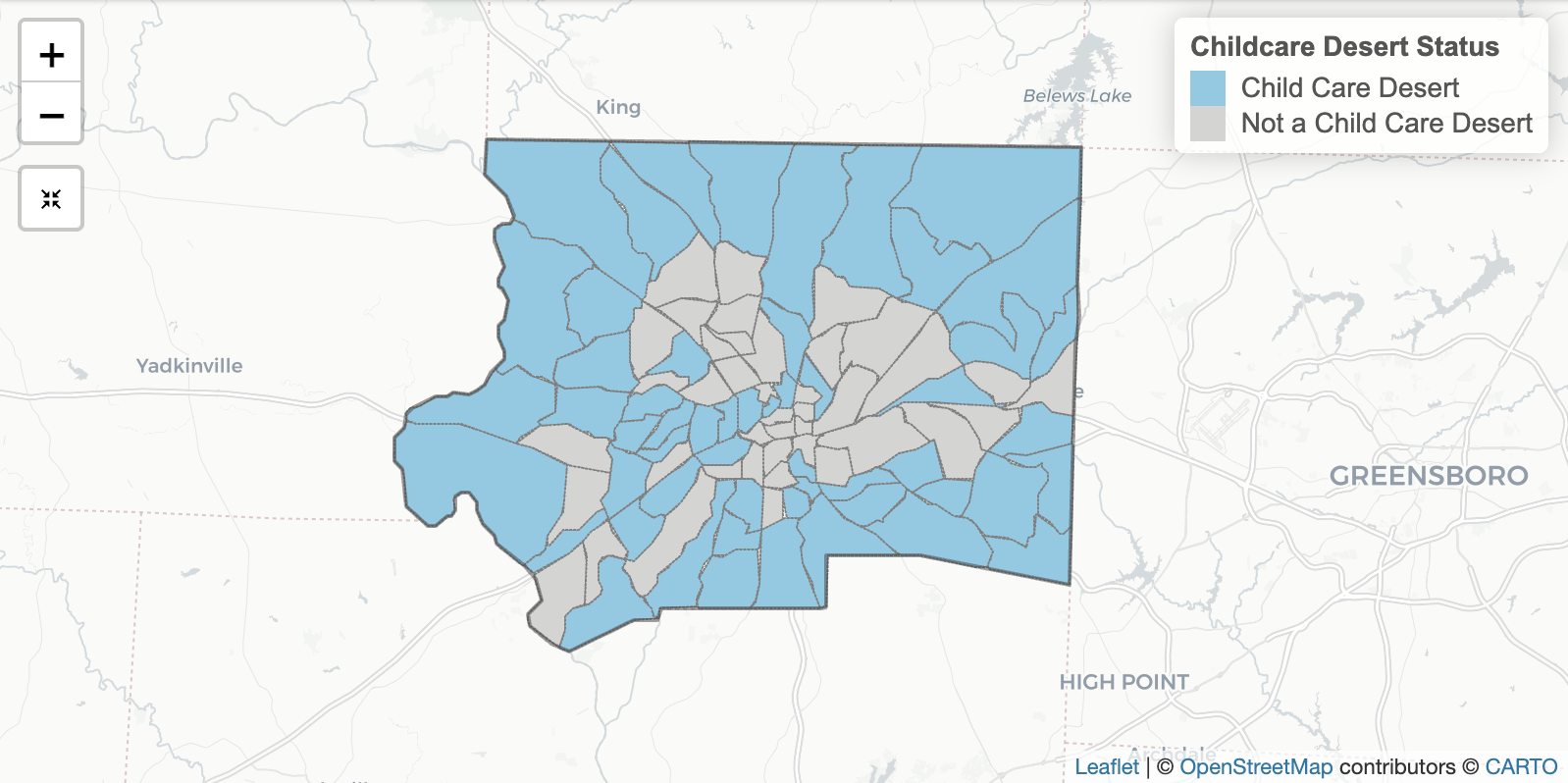
Click here to view an interactive version of the map above.
The CBPR Cohort felt it was important to include a similar map of housing values for context:

More maps that the cohort suggested could provide important context for this information can be found at the Forsyth County Neighborhood Opportunity Atlas.
Data Notes
Households in Childcare Deserts
About the Measures
- This does not reflect the quality of these childcare facilities.
- Childcare slots represent the total number of children who can be served in a childcare facilities. Slots may not be available to new families seeking childcare even if they exist. For example, a classroom may be full. Its slots would show up as existing, but it could not enroll additional children.
- This analysis does not take into account the age of the children or slots. For example, adequate 4-year-old childcare may be available, but not enough infant care.
- Families may not prefer to place their children in care in the census tract where they live.
- Analysts are at least 95% confident that the apparent differences between Black/African American and white, non-Hispanic households with children under 5 represent real differences, but the apparent difference between Black and African American households and Hispanic or Latine households may not be real.
- The apparent differences between female householders with no spouse present and other household types likely represent real differences, but the differences between other household types may not be real.
Data Sources
- North Carolina Division of Child Development and Early Education Child Care Statistical Report for August 2025
- American Community Survey (ACS) 2019-2023 5-year data
Citations
- North Carolina Department of Health and Human Services, Division of Child Development and Early Education. Child Care Statistical Report (August 2025). Retrieved from https://ncchildcare.ncdhhs.gov/County/Child-Care-Snapshot/Child-Care-Statistic-Report
- U.S. Census Bureau (2024). Sex by Age [Tables B01001, B01001B, B01001H, and B01001I]. 2023 American Community Survey 5-Year Estimates. Retrieved from data.census.gov.
- U.S. Census Bureau (2024). Poverty Status in the Past 12 Months of Families by Family Type by Presence of Related Children Under 18 Years by Age of Related Children [Tables B17010, B17010B, B17010H, and B17010I]. 2023 American Community Survey 5-Year Estimates. Retrieved from data.census.gov.
- Malik, R., & Hamm, K. (2017, August 30). Mapping America’s child care deserts – center for american progress. The Center for American Progress. https://www.americanprogress.org/article/mapping-americas-child-care-deserts/